
The Best NBA Shooters of All Time, Beyond the 3-Point Line
Stephen Curry leads our all-around NBA shooting ranking. Compare eight greats by accuracy, workload, mid-range shooting, free throws and era.
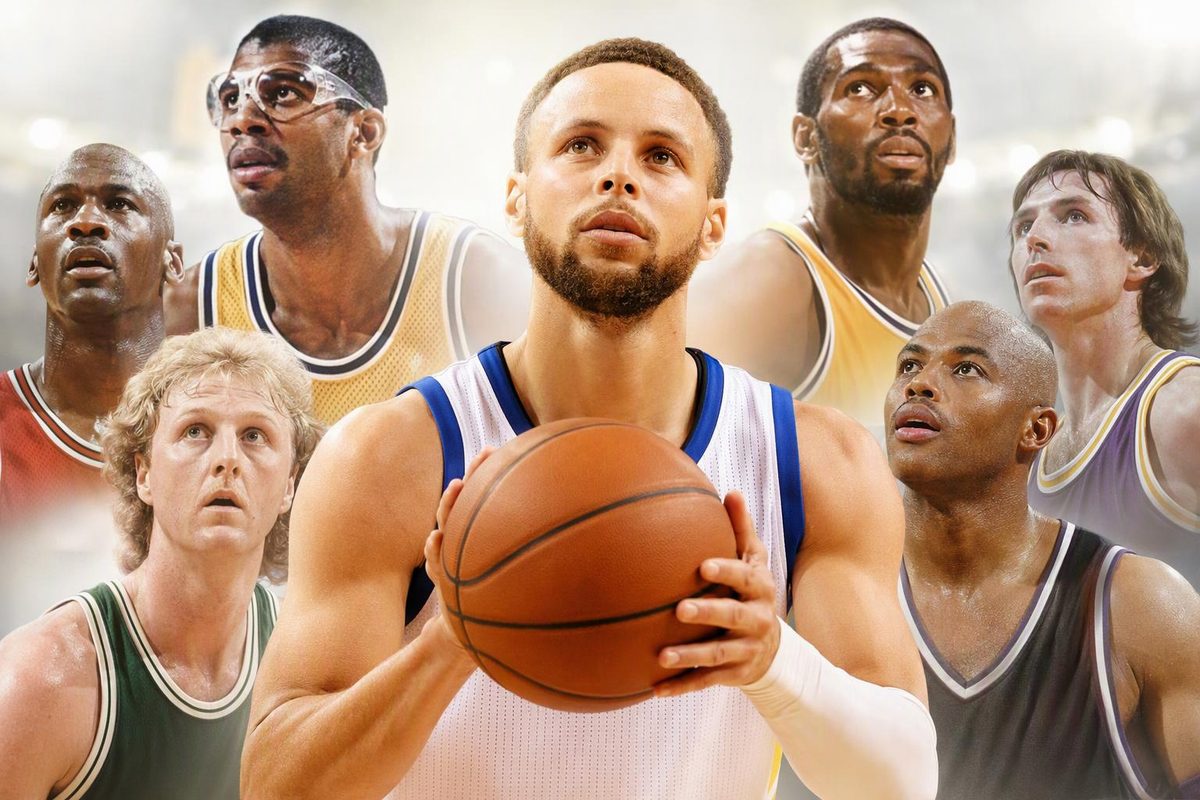
Stephen Curry is our choice as the best shooter in NBA history. His case combines exceptional 3-point accuracy and volume with elite free-throw shooting—not merely a large collection of made threes.
The harder question is who comes next. Steve Nash’s accuracy, Kevin Durant’s mid-range shooting and Ray Allen’s perimeter workload represent different kinds of excellence. This ranking considers shooting across distances, rather than repeating a list of the best 3-point shooters of all time.
What counts as great shooting?
This is an editorial NBA ranking, not an official league statistic. We emphasize demonstrated jump-shooting range and free throws, rather than scoring totals or finishing at the rim. The main considerations are:
- Accuracy: How often did the player make the shots he attempted?
- Workload and difficulty: Was he creating shots against a defense or finishing opportunities created by teammates?
- Range: Did his shooting extend from mid-range to the 3-point line and free-throw line?
- Sustained performance: Did the skill hold up over seasons and in the playoffs?
Era matters before comparing totals. A player’s opportunities depend on team pace, minutes and how often his offense uses particular shots. The NBA introduced the 3-point shot in 1979–80 and used a shorter line from 1994–95 through 1996–97. Career totals therefore cannot measure shooting ability on equal terms across generations. Sources: Lakers shooting-club history, NBA’s 3-point history.
One useful benchmark is 50–40–90: at least 50% on all field goals, 40% on threes and 90% on free throws over a season, with the applicable league qualifying minimums. It tests several shooting skills, but it is evidence—not an automatic ranking system. NBA explanation.
The ranking
1. Stephen Curry
Curry’s 2015–16 regular season is the strongest compact argument: 402 made threes, 45.4% from 3-point range, 50.4% overall and 90.8% at the line, while averaging 30.1 points. That is extraordinary accuracy attached to a major scoring workload. NBA MVP announcement.
Shot creation strengthens the case. The NBA’s 2021 analysis distinguished Curry from Allen and Reggie Miller because he took more of his threes off the dribble: 54% of his 3-point attempts were pull-ups over the eight seasons covered by Second Spectrum tracking. He was not dependent on receiving an open catch to produce elite perimeter shooting. NBA analysis.
2. Steve Nash
Nash finished his NBA career at 42.8% from three and 90.4% on free throws, and recorded four 50–40–90 seasons. Those repeated seasons—not one unusually hot year—make him our second choice. NBA career profile, Lakers shooting-club history.
The limitation is volume. Nash often preferred creating a teammate’s shot to taking his own. We give his sustained accuracy substantial weight, without assuming he would have maintained identical percentages under Curry’s workload.
3. Kevin Durant
Durant earns this position because an all-around shooting ranking should reward excellence inside the arc. In 2022–23, he shot 56.0% overall, 40.4% from three and 91.9% at the line. In 2023–24, he led the NBA in mid-range field goals made per game at 3.3. NBA biography.
The overall field-goal percentage includes finishes near the basket, so it cannot stand alone. More directly, the NBA’s 2021 analysis reported that Durant made 51.2% of his mid-range attempts in its preceding five-season sample. He and Chris Paul were the only players above 50% with at least 300 such attempts. That is evidence of mid-range accuracy, not just production. NBA shooting analysis.
4. Ray Allen
Allen’s accuracy survived changes in role and postseason defenses. He shot 40.0% from three in the regular season and 40.1% in the playoffs across his completed NBA career. Before becoming a complementary scorer in Boston and Miami, he averaged 24.6 points over his four full Seattle seasons. NBA career retrospective.
That combination matters more than the famous 2013 Finals shot alone: Allen demonstrated shooting value as both a leading scorer and a player working around other stars.
5. Larry Bird
Bird’s case rests on broader accuracy, not modern-sized 3-point totals. He recorded two 50–40–90 seasons, finished at 49.6% overall and 88.6% on free throws, and led the league in free-throw percentage four times. Shooting-club history, NBA legends profile.
His lower-volume perimeter record limits direct comparisons with Curry or Allen. It does not erase the evidence that he was an exceptional shooter across multiple parts of the court.
6. Dirk Nowitzki
Nowitzki belongs because shooting is not synonymous with shooting threes. His one-legged fadeaway and ability to operate on the perimeter gave Dallas a different kind of shooting threat at power forward. He also recorded a qualifying 50–40–90 season. NBA retrospective, shooting-club history.
We value that inside-arc versatility here. A ranking focused exclusively on long-range shooting would place him differently.
7. Reggie Miller
Miller retired with 2,560 regular-season threes. He ranked in the NBA’s top 10 in made threes in each of his first 15 seasons, including 11 top-five finishes—better evidence of era-relative volume than his current position on a career leaderboard. NBA historical analysis.
His constant movement through screens was part of the shooting skill: he repeatedly created usable shooting windows without dominating the ball. He also led the NBA in free-throw percentage four times, giving his case substance beyond the arc. NBA legends profile.
8. Klay Thompson
Thompson made at least 200 threes in every season from 2012–13 through 2018–19. Through 2022–23, his career accuracy stood at 41.6% from three and 85.2% on free throws. Those sustained results are more useful for this comparison than any single scoring eruption. NBA biography.
He makes this list primarily for perimeter shooting. Giving greater weight to free throws and inside-arc versatility keeps him below the leading all-around candidates.
Why one percentage cannot settle the argument
Field-goal percentage treats a made two and a made three identically. In a hypothetical 10-shot sample, five made twos produce 10 points and 50% FG%; four made threes produce 12 points and 40% FG%.
Effective field-goal percentage accounts for that scoring difference by giving made threes extra weight. The NBA defines it as an adjustment for threes being 1.5 times as valuable as twos. But it still does not distinguish an open dunk from a difficult jumper. NBA stat glossary.
For an all-time shooting comparison, read the percentage alongside the attempts, distances and role. That is why Curry leads this ranking—and why Nash, Durant and Allen can reasonably change places when the emphasis changes.