
The Best 3-Point Shooters of All Time, Ranked With Context
Stephen Curry leads our NBA ranking. Compare the greatest 3-point shooters by accuracy, volume, playoff shooting and era—not just career totals.
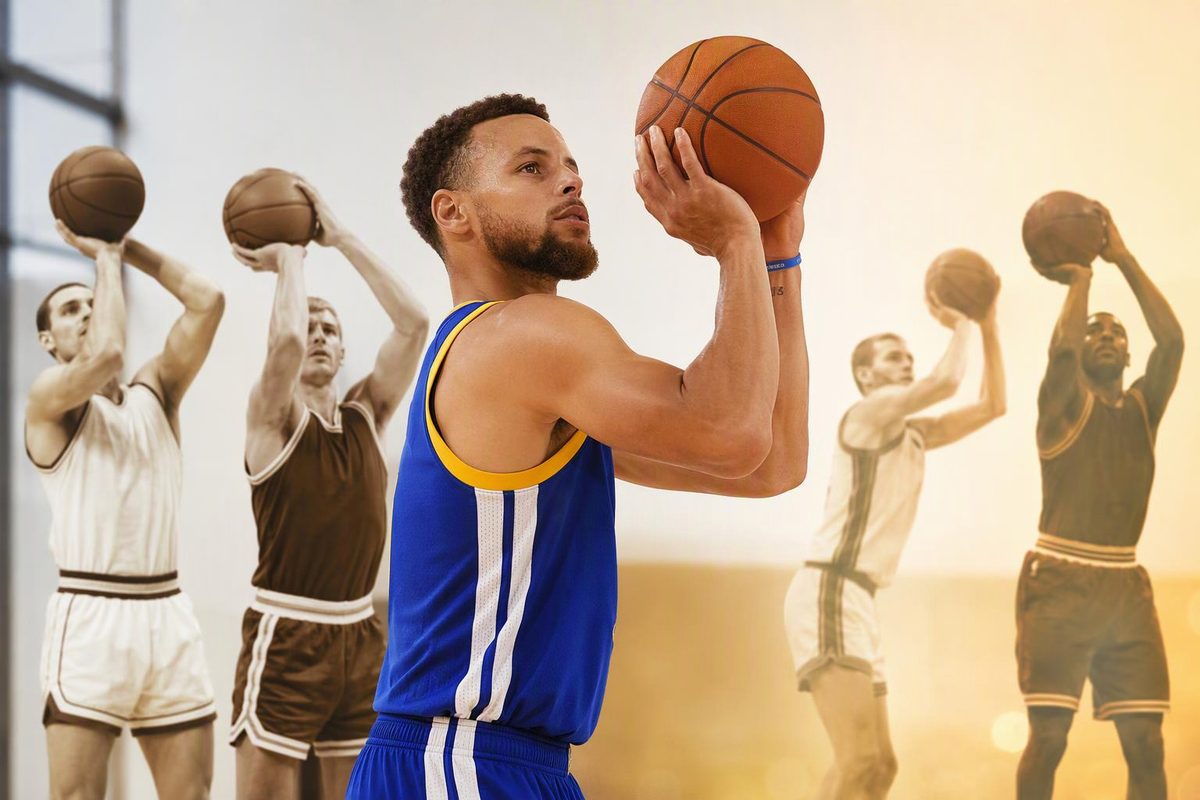
Stephen Curry is the best 3-point shooter in NBA history. His case combines the most career makes with exceptional accuracy on an enormous number of attempts. Ray Allen, Klay Thompson and Reggie Miller lead the next group, but their order depends on how much weight you give longevity, peak shooting and era.
This ranking covers NBA shooting, not every basketball league. It weighs career accuracy and volume most heavily, with playoff performance, shot creation and historical context helping separate close candidates. A player creating a shot off the dribble has a different assignment from one receiving an open pass; career percentages do not distinguish those jobs.
Our top eight NBA 3-point shooters
Three-point percentage, or 3P%, is made threes divided by attempted threes, multiplied by 100. It measures accuracy—not how often a player shoots or how difficult those attempts are. The same made-shots/attempted-shots principle underlies field-goal percentage.
The figures below are NBA regular-season career statistics through 2025–26, checked October 1, 2026. They come from the NBA’s all-time leaderboard. The ranking is our editorial assessment, not an official league award or a formula-generated result. 3PM means made threes; 3PA means attempted threes.
| Our rank | Player | Career 3PM | Career 3PA | Career 3P% |
|---|---|---|---|---|
| 1 | Stephen Curry | 4,248 | 10,073 | 42.2% |
| 2 | Ray Allen | 2,973 | 7,429 | 40.0% |
| 3 | Klay Thompson | 2,899 | 7,089 | 40.9% |
| 4 | Reggie Miller | 2,560 | 6,486 | 39.5% |
| 5 | Kyle Korver | 2,450 | 5,715 | 42.9% |
| 6 | James Harden | 3,390 | 9,323 | 36.4% |
| 7 | Damian Lillard | 2,804 | 7,556 | 37.1% |
| 8 | Steve Nash | 1,685 | 3,939 | 42.8% |
1. Stephen Curry: the strongest combination of volume and accuracy
Curry has attempted more than 10,000 threes while making over 42%. That combination matters more than either his makes record or his percentage alone.
His 2015–16 season provides the clearest illustration: 402 makes in 886 attempts, or 45.4%, across 79 games. That is roughly 11.2 attempts per game, calculated from those totals—not a small sample of carefully selected shots. The NBA documents that season, and the single-season leaderboard still places it first.
His postseason record reinforces the choice: Curry leads with 650 playoff threes, separate from his regular-season total. Source: NBA playoff leaderboard.
2. Ray Allen: sustained excellence over a huge career sample
Allen’s 2,973 makes at 40.0% establish a substantial accuracy-and-longevity benchmark. We give him the narrow edge over Thompson for the larger career shooting sample and total output.
His accuracy also held up in the postseason: 385 makes at 40.1%. That is useful evidence across hundreds of attempts, rather than a ranking built around one famous shot. Source: NBA playoff leaderboard.
3. Klay Thompson: career accuracy backed by extraordinary shooting peaks
Thompson’s regular-season percentage exceeds Allen’s, and his 501 playoff makes at 40.5% give him an especially strong postseason case. Readers placing more weight on playoff output can reasonably put him second, although playoff totals also reflect how often a player’s teams advance. Source: NBA playoff leaderboard.
His explosive ceiling is illustrated by October 29, 2018, when he made 14 of 24 threes against Chicago in just 26 minutes, 33 seconds. The official box score captures the performance; his career record is what makes it more than an isolated hot night.
4. Reggie Miller: a career total that needs era context
Miller’s 39.5% is slightly below Allen’s and Thompson’s, but his 2,560 makes should not be judged as though he played with today’s shooting opportunities.
His highest season average was 6.6 three-point attempts per game, compared with Allen’s 8.4. Curry had already produced multiple seasons above 11 attempts per game when the NBA made that comparison in 2021. Miller’s lower volume helps explain why modern players can pass his total without automatically becoming better shooters. Source: NBA’s Curry–Miller comparison.
5. Kyle Korver: elite accuracy without a small-sample explanation
Korver’s 42.9% across 5,715 attempts is the highest career percentage in this eight-player group. His combination of accuracy and accumulated makes earns him a place ahead of several more prominent scorers.
He also led the league in 3-point accuracy four times, including 53.6% in 2009–10. That season was 59 makes on 110 attempts; his 2014–15 season offered a larger sample, with 221 makes on 449 attempts, or 49.2%. We weigh his career record more heavily than either peak. Sources: NBA profile of Korver, NBA season totals.
6–8. James Harden, Damian Lillard and Steve Nash
Harden ranks second in career makes, but sixth here because his 36.4% accuracy trails the five players above him. His shot-creation burden keeps him firmly in the discussion: the NBA’s account of his scoring career explains how his step-back creates separation for jump shots. His playoff accuracy is lower, at 33.7%, which also weighs against moving him higher. Source: NBA playoff leaderboard.
Lillard combines enormous volume with range extending well beyond the arc. Portland’s account of his deep shooting explains how that threat draws defenders farther out and creates driving and passing space. His 37.1% should therefore be read alongside his role, not treated as a clean comparison with a spot-up specialist.
Nash offers the opposite statistical case: fewer attempts, but 42.8% accuracy across nearly 4,000 threes. We place him eighth because that efficiency deserves recognition, while his lower total output limits his claim against the higher-volume candidates.
Why Steve Kerr and Larry Bird are not in this top eight
Steve Kerr leads Basketball-Reference’s qualified career percentage list at 45.4%. That list requires at least 250 made NBA threes. Kerr finished with 726 makes on 1,599 attempts—excellent accuracy, but a much smaller shooting workload than Curry’s. Sources: qualified percentage leaderboard, qualification requirements, NBA career statistics.
There is also a rules difference: the NBA used a uniform 22-foot line from 1994–95 through 1996–97, before restoring the longer arc. Kerr made 321 of 644 threes in those seasons, or 49.8%, calculated from his NBA totals. Those shots count fully, but the distance belongs in any cross-era interpretation—for everyone who played in those seasons, not just Kerr. Sources: historical research, Kerr’s season totals.
Larry Bird finished with 649 threes at 37.6%, including four consecutive seasons at 40% or better from 1984–85 through 1987–88. His smaller three-point sample makes him harder to place in a ranking specifically about NBA threes, rather than overall shooting ability. We should recognize that record without inventing what he would have shot on modern volume. Source: NBA career statistics.
Most makes, highest percentage and best shooter answer different questions. Curry is the strongest overall choice because his record combines volume and accuracy; the closer arguments below him require attention to the shots behind the numbers.